

State of AI - Online
AI-Assisted Software Development with GitHub Copilot
Discover how to revolutionize your software development workflow with GitHub Copilot and advanced AI tools in this comprehensive remote training designed for developers, technical leads, and engineering managers. Over five half-day sessions, you will gain hands-on experience mastering AI-assisted coding fundamentals, safe legacy code modernization, and accelerated greenfield project development. Learn to implement enterprise governance, enhance code quality, and boost productivity through practical AI workflows, automated testing, and prompt engineering techniques. Whether you’re looking to modernize existing systems or rapidly deliver new features, this training equips you with essential strategies and templates to harness AI effectively while managing risk and technical debt. Join this program to transform your team’s software engineering approach and stay ahead in the AI-powered development revolution.
This is an online event.
Click here to register for this event!
Transform Your Development Workflow with GitHub Copilot and Advanced AI Tools Master the future of software engineering through three comprehensive training programs designed for modern development teams.
- Duration: Five half-days of 4 hours each (20 hours total). Note that hours are shown in the Central time zone.
- Delivery: Remote (instructor in California; students distributed, class size 6–20)
- Audience: Software developers who are familiar with GitHub and Copilot novices
Who Should Attend
Software developers, technical leads, and engineering managers ready to leverage AI for accelerated development, legacy system modernization, and greenfield project creation. You should have some experience using ChatGPT, Claude, or a similar LLM, plus some familiarity with GitHub Copilot and software development fundamentals.
What You'll Master
🚀 AI-Assisted Development Fundamentals (1 day) Break into AI-powered coding with GitHub Copilot. Learn enterprise governance, hands-on implementation across different Copilot modes, and software engineering best practices that maintain code quality while dramatically boosting productivity.
🔧 Legacy Code Transformation (2 days) Turn your brownfield nightmares into evergreen assets. Master safe legacy code modification, automated documentation generation, AI-assisted testing, and incremental modernization strategies that reduce technical debt while minimizing risk.
⚡ Greenfield Development Acceleration (2 days) Transform requirements into working software faster than ever. Learn structured AI workflows, instruction files, custom chat modes, and prompt engineering techniques that turn concepts into production-ready code.
Why This Training Matters The AI development era is happening now. Developers using AI tools report 30–50% productivity gains, but only when used correctly. This training teaches you to harness AI as a force multiplier while avoiding common pitfalls that lead to poor code quality and technical debt.
You'll gain:
- Immediate productivity improvements through proper AI tool usage
- Enterprise-ready governance frameworks for team adoption
- Risk management strategies for production environments
- Template libraries and workflows for ongoing success
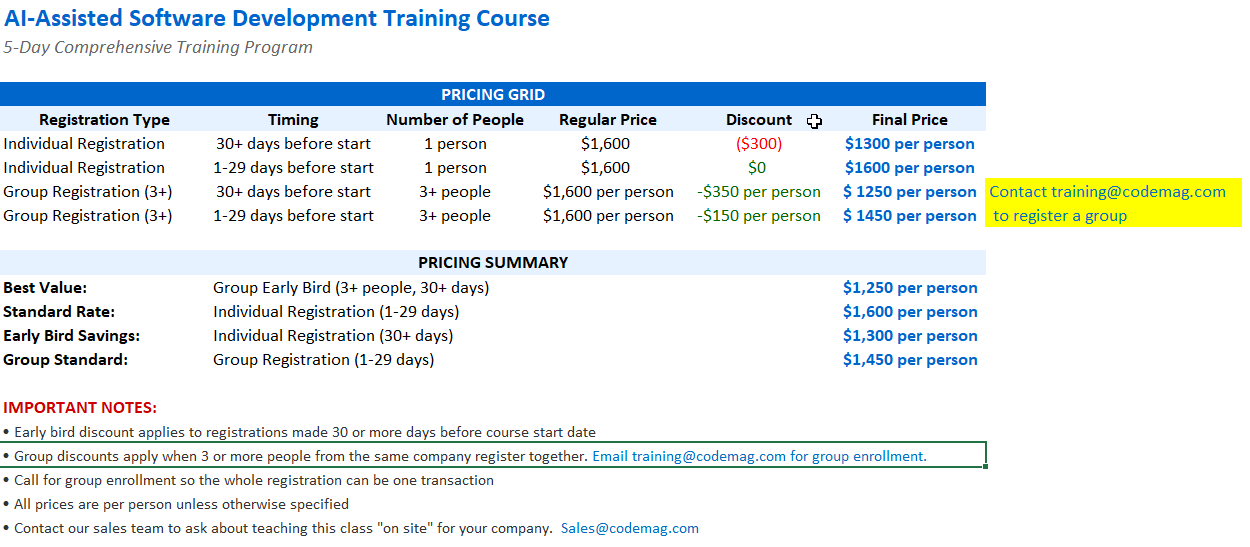
Cost Matrix
What's the Tech Stack for this Class?
- IDE: VS Code with the GitHub Copilot Extension
- SCC: GitHub
- Coding Languages: C#, TypeScript, Vue.js
NOTE: The emphasis is on AI assistance and how to use AI effectively to generate code. The techniques are implementable in any tech stack.
Training 5+ developers? Let's customize it.
Our AI-assisted development techniques work with any tech stack—but they're even more powerful when taught using your actual tools and project types. We'll tailor the class to your team's real-world needs.
Session Agenda:
| Monday, February 9, 2026 | |
| 10:00AM to 10:30AM | Module 1: Foundations |
| 10:30AM to 11:00AM | Module 2: GitHub Copilot for Teams |
| 11:00AM to 12:00PM | Module 3: Hands-On Copilot Usage |
| 12:00PM to 1:00PM | |
| 1:00PM to 3:00PM | Module 4: AI Assisted SD Workflow |
| Tuesday, February 10, 2026 | |
| 10:00AM to 10:30AM | Module 1: Setting the Foundation |
| 10:30AM to 11:00AM | Module 2: Mastering AI Context Management |
| 11:00AM to 12:00PM | Module 3: Instruction Files & Custom Instructions |
| 12:00PM to 1:00PM | |
| 1:00PM to 3:00PM | Module 4: Understanding Legacy Systems with AI |
| Wednesday, February 11, 2026 | |
| 10:00AM to 11:00AM | Module 5: Building Safety Nets |
| 11:00AM to 12:00PM | Module 6: Safe Legacy Code Modification |
| 12:00PM to 1:00PM | |
| 1:00PM to 3:00PM | Module 7: Strangling Technical Debt |
| Thursday, February 12, 2026 | |
| 10:00AM to 11:00AM | Module 1: AI-Assisted Workflow |
| 11:00AM to 12:00PM | Module 2: Project Requirements & Foundation |
| 12:00PM to 1:00PM | |
| 1:00PM to 3:00PM | Module 3: Three AI Development Approaches |
| Friday, February 13, 2026 | |
| 10:00AM to 12:00PM | Module 4: Integration & Best Practices |
| 12:00PM to 1:00PM | |
| 1:00PM to 3:00PM | Module 5: Hands-On Implementation |
| Monday, February 9, 2026 |
| Monday, AI Assisted SD Fundamentals |
| 10:00AM to 10:30AM Module 1: Foundations |
| 10:30AM to 11:00AM Module 2: GitHub Copilot for Teams |
| 11:00AM to 12:00PM Module 3: Hands-On Copilot Usage |
| 12:00PM to 1:00PM Lunch Break |
| 1:00PM to 3:00PM Module 4: AI Assisted SD Workflow |
| Tuesday, February 10, 2026 |
| Tuesday: Foundations & Context Management |
| 10:00AM to 10:30AM Module 1: Setting the Foundation |
| 10:30AM to 11:00AM Module 2: Mastering AI Context Management |
| 11:00AM to 12:00PM Module 3: Instruction Files & Custom Instructions |
| 12:00PM to 1:00PM Lunch Break |
| 1:00PM to 3:00PM Module 4: Understanding Legacy Systems with AI |
| Wednesday, February 11, 2026 |
| Wednesday: Legacy Code Transformation |
| 10:00AM to 11:00AM Module 5: Building Safety Nets |
| 11:00AM to 12:00PM Module 6: Safe Legacy Code Modification |
| 12:00PM to 1:00PM Lunch Break |
| 1:00PM to 3:00PM Module 7: Strangling Technical Debt |
| Thursday, February 12, 2026 |
| AI-Assisted Software Development: Greenfield Devel |
| 10:00AM to 11:00AM Module 1: AI-Assisted Workflow |
| 11:00AM to 12:00PM Module 2: Project Requirements & Foundation |
| 12:00PM to 1:00PM Lunch Break |
| 1:00PM to 3:00PM Module 3: Three AI Development Approaches |
| Friday, February 13, 2026 |
| AI-Assisted Software Development: Greenfield Devel |
| 10:00AM to 12:00PM Module 4: Integration & Best Practices |
| 12:00PM to 1:00PM Lunch Break |
| 1:00PM to 3:00PM Module 5: Hands-On Implementation |
Session Detail:
Module 1: Foundations
Introduction to AI-Assisted Development
- Why AI is revolutionizing software development and its career impact
- General introduction to Large Language Models (LLMs)
- Conceptual overview of how LLMs work with code
- Capabilities and limitations of LLMs in coding contexts
- Software engineering practices vs “vibe coding”
- Essential do's and don'ts for AI-assisted development
Module 2: GitHub Copilot for Teams
Enterprise Adoption and Governance
- Organizational benefits: accelerated development, improved documentation, enhanced testing
- Risk assessment: IP leakage, code quality, developer overreliance
- Governance and compliance considerations
- Data protection and licensing safeguards
- Deployment options comparison (Individual vs Business vs Enterprise plans)
- Best practices for safe organizational use
Module 3: Hands-On Copilot Usage
Practical Implementation
- GitHub Copilot overview and VS Code integration
- Understanding instructions vs prompts vs custom chat modes
- Installation, configuration, and team setup
- Working with different Copilot modes (Ask, Edit, Agent, Custom)
- Exercise #1: Forking course repositories
- Exercise #2: Building a simple calculator with progressive features using test-driven development
- Real-world coding scenarios and prompt engineering
Lunch Break
Monday lunch break
Module 4: AI Assisted SD Workflow
Consolidation and Next Steps
- Review of learning outcomes
- Open Q&A session
- Future learning opportunities and resources
- Homework assignment: Finding and preparing a legacy codebase for continued practice
Module 1: Setting the Foundation
Understanding Legacy vs. Evergreen Code
- What defines legacy code (and what doesn't)
- Why codebases degrade over time
- The evergreen code philosophy: “If we rewrote it today, it would look exactly like this”
- Building respect, not fear, for working systems
Pre-AI Checklist: Essential Safety Measures
- Backup and rollback strategies (branching, commits, archiving)
- Testing confidence frameworks
- Change review processes
- Incremental change methodology
Module 2: Mastering AI Context Management
Managing GitHub Copilot Effectively
- Treating Copilot as a managed junior developer
- Understanding context windows and token limitations
- Prompt design best practices
- Model selection strategies (GPT-4o, Claude Sonnet, etc.)
Advanced Context Techniques
- File and folder mentions (#-syntax)
- Spaces and Knowledge Bases integration
- Premium usage monitoring and optimization
- Token estimation and context overflow detection
Lunch Break
Tuesday lunch break.
Module 4: Understanding Legacy Systems with AI
Documentation Generation and Code Analysis
- Automated README and documentation updates
- Architecture diagram generation
- Complex code explanation and mapping
- Identifying technical debt hotspots
Hands-On Exercise: Legacy Code Documentation
- Generate development and deployment guides
- Create architecture diagrams
- Update project documentation
- Cross-validate with multiple AI models
Module 5: Building Safety Nets
Test Automation and Code Quality
- AI-assisted test generation (unit, integration, E2E)
- Intelligent linting beyond static analysis
- Coverage analysis and test adequacy assessment
- Automated quality gates
Creating Robust Testing Frameworks
- Generating comprehensive test suites
- Test review and validation strategies
- Balancing test coverage with maintainability
Module 6: Safe Legacy Code Modification
Compliance and Gap Analysis
- Comparing implementations against instruction files
- Automated issue generation from compliance gaps
- Prioritizing technical debt remediation
- Creating actionable remediation plans
Multi-Model Implementation Comparison
- Implementing changes with different AI models
- Comparing approaches and outcomes
- Risk assessment and quality evaluation
- Best practice synthesis
Lunch Break
Wednesday lunch break.
Module 1: AI-Assisted Workflow
- High-level workflow from requirements to solution
- Role of stakeholders and AI in each phase
- Process visualization and workflow diagrams
Module 2: Project Requirements & Foundation
- Defining business rules and workflows
- Technology stack and architecture decisions
- Introduction to Zeus.Academia.2 project example
- Conceptual models and Object Role Models
- Use cases and data capture scenarios
Exercise: Create project requirement instructions
Lunch Break
Thursday lunch break.
Module 3: Three AI Development Approaches
Instruction Files:
- Persistent behavioral guidelines for AI
- Coding standards and security policies
- Repository-wide consistency
Prompt Files:
- Executable task templates
- Structured workflows for specific tasks
- Repeatable automation patterns
Module 4: Integration & Best Practices
- Layered integration approach
- When to use each method
- Real-world implementation examples
- Common pitfalls and how to avoid them
Lunch Break
Friday lunch break.
Module 5: Hands-On Implementation
- Creating custom chat modes with personas
- Generating implementation prompts and verification
- Agent configuration with safe commands
- Testing and validation workflows