

Why Local AI Matters – The Case for Personal Digital Sovereignty (Series)
June 3, 2026 | Online, Virtual
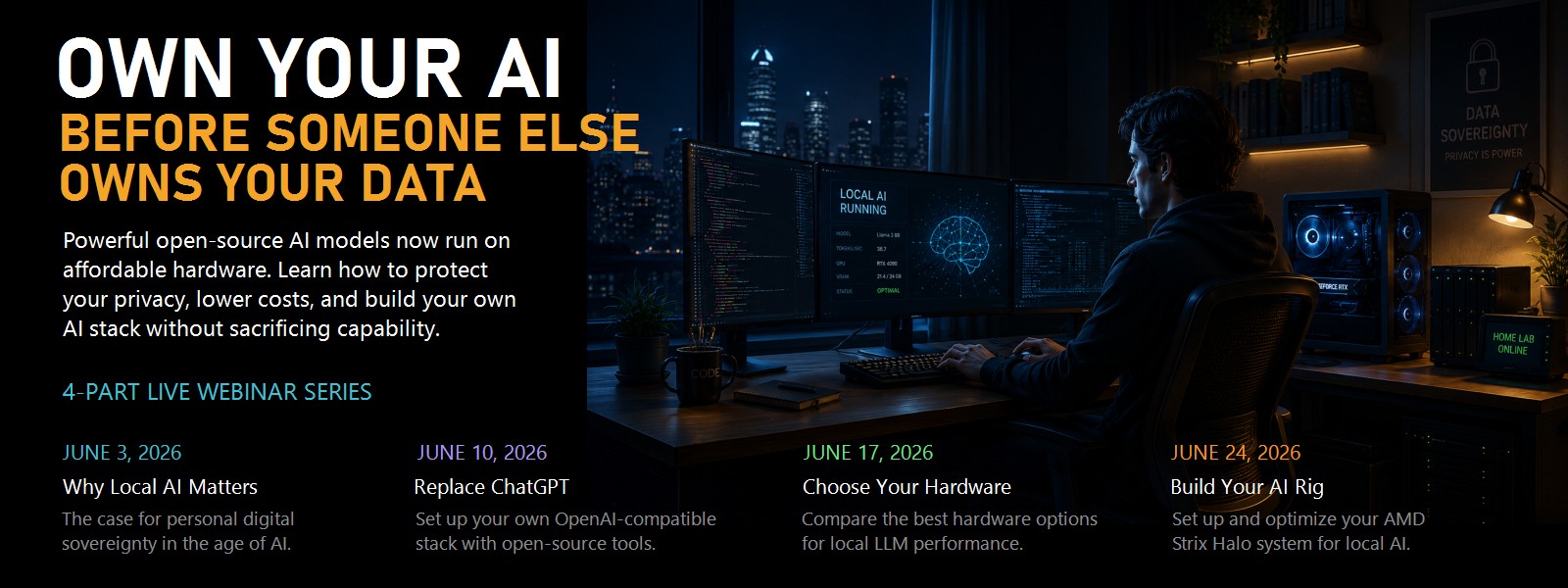
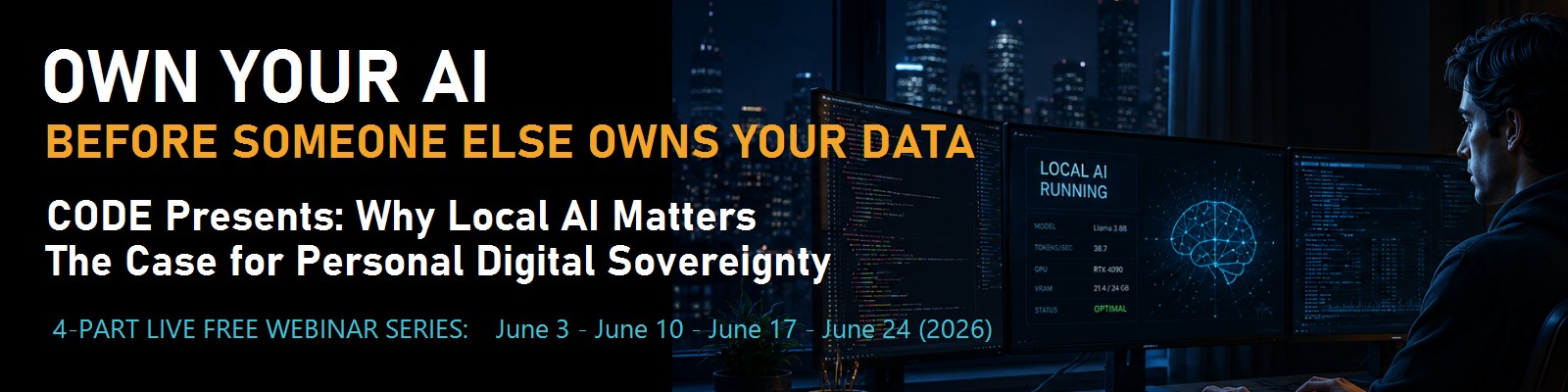
Own Your AI - Before Someone Else Owns Your Data!
AI tools are now part of daily work—but who owns your data? In this four-part webinar series, CODE Consulting's Philipp Bauer makes the case for personal AI sovereignty: running powerful language models privately, on hardware you control. A different webinar broadcasts each Wednesday in June 2026; each session runs 15–30 minutes. Sign up once and you're registered for all four. Learn what's changed in the open-source LLM ecosystem, what consumer and business hardware options exist, and how to replace cloud-based AI interfaces with privacy-first, open-source alternatives without sacrificing capability.
This event took place on Wednesday, June 3, 2026.
Click here to register for this event!
You can sign up once for one of these webinars and join any of them on the broadcast date and time (even if you already missed some of the events). Recordings will be available after the events.
-
JUNE 3, 2026
Why Local AI Matters: The case for the personal digital sovereignty in the age of AI.
-
JUNE 10, 2026
Replace ChatGPT: Learn how to set up your own OpenAI-compatibl stack with open-source tools.
-
JUNE 17, 2026
Choose Your Hardware: Compare and understand the best hardware options for your local LLM performance.
-
JUNE 24, 2026
Build Your AI Rig: Learn how to set up and optimize your AMD Strix Halo system for local AI.
When: Four consecutive Wednesdays in June 2026 (3rd, 10th, 17th, 24th)- 12:00 pm Central Time (CT). The duration varies by webinar. Plan about 15-30 minutes each.
More Content
- Click here to watch the recording from the first webinar in the series.
- Also, read the related blog with links about why local LLMs matter.
AGENDA
| Wednesday, June 3, 2026 | ||
| 12:00PM | Part 1: Why Local AI Matters – The Case for Personal Digital SovereigntyBREAKOUT | Philipp Bauer |
| Wednesday, June 10, 2026 | ||
| 12:00PM | Part 2: Replacing OpenAI ChatGPT with Open-Source ToolsBREAKOUT | Philipp Bauer |
| Wednesday, June 17, 2026 | ||
| 12:00PM | Part 3: Hardware Options for Local LLM Inference StacksBREAKOUT | Philipp Bauer |
| Wednesday, June 24, 2026 | ||
| 12:00PM | Part 4: Setting up an AMD Strix Halo SystemBREAKOUT | Philipp Bauer |
| Wednesday, June 3, 2026 |
| 12:00PMBREAKOUT Part 1: Why Local AI Matters – The Case for Personal Digital Sovereignty Philipp Bauer |
| Wednesday, June 10, 2026 |
| 12:00PMBREAKOUT Part 2: Replacing OpenAI ChatGPT with Open-Source Tools Philipp Bauer |
| Wednesday, June 17, 2026 |
| 12:00PMBREAKOUT Part 3: Hardware Options for Local LLM Inference Stacks Philipp Bauer |
| Wednesday, June 24, 2026 |
| 12:00PMBREAKOUT Part 4: Setting up an AMD Strix Halo System Philipp Bauer |
SESSION DETAILS
Part 1: Why Local AI Matters – The Case for Personal Digital Sovereignty
We will look into the reasons why it’s very well worth considering building your own, local LLM stack. You’ll learn about the legal frameworks affecting your data online — not just regarding LLMs but in general. With the example of Europe and its movement towards digital sovereignty. And we’ll discuss when it makes financial sense to use your own infrastructure instead of APIs.
Part 2: Replacing OpenAI ChatGPT with Open-Source Tools
Learn how to set up your own ChatGPT clone with the open-source tool Open WebUI. This project has quickly become the go-to replacement for ChatGPT, matching and exceeding its features. Not only does it come with an agentic chat feature, but integrates memory, skills, MCP servers, speech-to-text/text-to-speech and allows you to extend the app with your own or community developed Python-based tools. We will go even further and show how you can host your own meta-search engine and automatic browser interaction tooling.
Part 3: Hardware Options for Local LLM Inference Stacks
We'll shed light on currently available hardware for use with freely available language models. Nvidia is firmly planted and dominating the data center space. Lacking GPUs with large memory options, they leave AMD and Apple both room to compete in the consumer space with their unified memory architectures that deliver up to 256GB (V)RAM.
Part 4: Setting up an AMD Strix Halo System
Learn how to set up an AMD Strix Halo system to run LLMs. Be prepared for a technical deep dive into how such a system can be set up in a flexible way with Proxmox for hosting virtual machines, setting up Docker and the configuration of LLM containers.